

The Hidden Labor of Authentic Storytelling: A Process of Discovery
Authentic storytelling is not a marketing tactic. It is a process of discovery that happens before content is created. This essay explores the invisible labor behind narrative clarity, why marketing teams absorb the cost of misalignment, and how narrative ethnography prepares organizations for authentic storytelling.
Key Takeaways
-
Authenticity emerges from upstream narrative clarity before messaging, marketing, or AI scaling begins.
-
Competing internal truths signal the need for listening, mapping, and synthesis, not faster execution.
-
By transforming chaos into coherent narrative infrastructure, it prepares marketing teams to operate from clarity rather than compensation.
AI can support storytelling only after narrative clarity exists
Scroll LinkedIn, and you will see the same plea repeated:
“Be more authentic.”
“Stop using AI to write your content.”
“We can tell when you are not being real.”
It is true. AI can scale the output of entire marketing strategies. For organizations with limited budgets or small teams, AI can be useful when applied downstream of narrative clarity. It can free capacity for the upstream human work that leads to real transformation.
These posts are meant to be encouraging. Yet they rarely reveal the process behind being authentic.
“Be more vulnerable.”
“Show emotions that connect with your reader.”
“Speak from your truth.”
They often end with an engagement question like, “How do you bring authenticity into your storytelling?”
Let me say this as clearly as my fingers will quickly allow me to type: Authenticity is not something one manufactures.
If you wake up tomorrow morning and your partner of ten years looks at you and says, “Starting on Monday, I will be more genuine with you,” would you trust them?
You would probably question the entire relationship leading up to that moment. Never mind trying to trust them afterward.
Treating Authenticity as Output
AI optimizes for what looks and sounds right, not what is true
AI is a relationship of inputs and outputs. It synthesizes information collected from various sources. As a deliverable, AI prioritizes what it believes looks good, sounds good, and might convert.
Without human refinement, large-scale AI-driven content strategies risk becoming diluted and perceived as inauthentic.
The Invisible Labor Behind Authentic Narratives
Authenticity is not a marketing tactic. It is a process of discovery that forms the foundation from which an organization’s core narrative develops.
It is the invisible labor that weaves together a company’s self-perception with the lived experiences of its supporters. Because this labor is invisible, it is often undervalued and made vulnerable to performance metrics such as lead counts, click-through rates, and impressions. These metrics measure the outputs of authentic storytelling, not its source.
Authentic storytelling requires presence, listening, and the ability to hold complexity without collapsing it into “easy answers.” As the demand for authenticity intensifies, the process through which it emerges requires clarification.
Authenticity is treated as a deliverable rather than a process
Most organizations approach discovery with a small set of stakeholder interviews, a review of the mission statement, and existing brand guidelines. Then marketing writes the content.
This is why marketing and communications teams are responsible for the visible labor. This includes social posts, email campaigns, blogs, and other deliverables.
But authenticity is not a deliverable. It is an expectation.
When organizations place responsibility for this invisible labor solely on marketing, often unintentionally as a structural default, costs inevitably arise. Consider a marketing manager tasked with writing a thought leadership piece featuring two executives who hold conflicting views of the organization’s direction.
To maintain alignment (and maybe even job security), the manager must craft a narrative that suggests coherence while concealing disagreement. Ambiguity becomes the strategy. Aspirational language becomes smoke.
It is not the manager’s role to surface internal conflict. Yet their work reflects the tension they are asked to manage.
Narrative chaos emerges in the gap between internal meaning and external experience
This creates a growing gap between internal meaning and external experience.
Emic truth refers to internal identity, meaning, and lived experience.
Etic reality reflects how external stakeholders experience the organization.
This gap produces narrative chaos, a signal that meaning has not yet been integrated. And yet, it is precisely within this space that an organization’s true core narrative can be discovered.
This is the work of narrative ethnography.
It involves navigating internal politics around organizational identity, translating jargon into plain language, holding multiple narrative threads simultaneously, and recognizing patterns across departments.
The process of being authentic is the process of discerning narrative chaos.
It is not comfortable work.
What Narrative Misalignment Really Costs
When narrative work is unowned, marketing absorbs the burden
When the invisible labor of reconciling conflicting narratives falls solely on marketing, the visible outputs inevitably reflect competing realities.
This is exhausting.
Organizations that do not address narrative misalignment upstream will continue to expect an overextended workforce to produce clarity from chaos. The cost of inauthenticity is not abstract. It affects trust, morale, and revenue.
But narrative chaos is not evidence of failure. It is evidence.
Chaos reveals where meaning needs to be reconciled. It signals that multiple truths are present inside the organization and have not yet been listened to, mapped, or reconciled. Chaos is raw material. It reveals where meaning is fractured, where identity is contested, and where narrative work is required.
This work does not require organizations to change who they are or what they do. It requires them to pause long enough to listen, map, and name the narratives already present so marketing can operate from clarity rather than compensation.
Preparing the ground allows marketing to succeed
Expecting marketing teams to carry this labor alone is not sustainable.
Narrative ethnographers, though often positioned as outsiders, engage deeply with organizations to surface both internal and external truths. Their role is not to replace marketing. Their role is to prepare the ground so marketing can succeed.
This shift allows marketing teams to focus on what they were hired to do. They can craft and amplify messaging that resonates because it is rooted in truth.
A Different Order of Operations
Narrative clarity follows a sequence that cannot be rushed
Narrative ethnography does not replace marketing. It prepares you for it.
Narrative clarity follows a different order of operations.
First comes narrative foundation work through narrative ethnographic methods such as stakeholder interviews and organizational immersion.
Next comes distinguishing lived truth from aspiration.
Competing narratives are then synthesized into coherence.
From this synthesis, the organization’s core narrative is revealed. This is the fire.
Finally, narrative architecture is built on lived reality.
This is invisible labor.
This is human work.
Recognize the visible labor of marketing teams and measure their work accordingly.
Once an organization has authentic narrative architecture, marketing teams can deliver external messaging that resonates with real experiences. Content remains authentic because it is rooted in truth.
Then, and only then, AI can be used to scale from clarity.
AI can help scale fire. It cannot manufacture it.
AI can execute from alignment. It cannot create it.
*Examples in this piece are composites drawn from multiple experiences across organizations. Details have been changed to protect confidentiality while preserving the truth of the patterns observed.

What is Narrative Ethnography?
Most purpose-driven organizations have a clear mission but struggle to articulate a clear narrative. Not because they lack substance — but because their story is fragmented, inherited, or buried in jargon. Narrative ethnography is the discipline that uncovers the culture beneath the communication so organizations can speak from a place of truth, not performance.
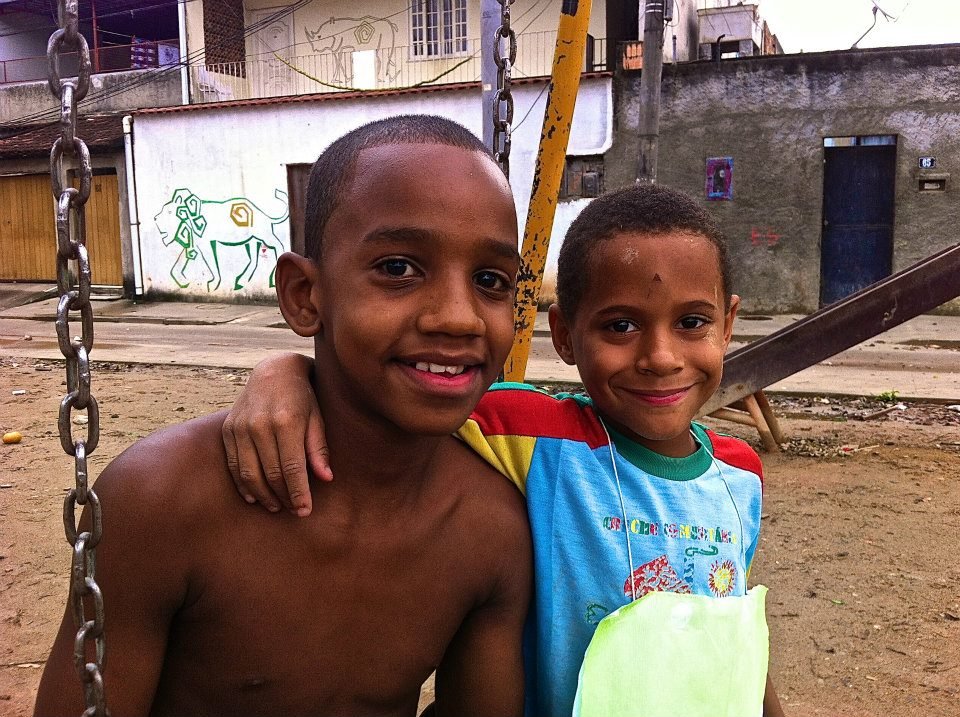
Photo by author. Rio de Janeiro, Brazil, 2012.
Most purpose-driven organizations aren’t struggling because they lack a mission. They struggle because their narrative is scattered, inherited, or stuck in “impact jargon” that doesn’t feel like them.
Narrative ethnography helps organizations return to the truth at the center — the lived experiences, values, tensions, and aspirations that shape who they are.
When most people hear me say, “I’m an anthropologist,” it’s usually followed by, “So you dig up bones and stuff like that?” It’s frustrating to hear that in 2025, anthropology is still mostly associated with fossils and artifacts. The other day, I even came across a reel on Instagram listing college majors by highest unemployment rate, and anthropology ranked number one.
That stung a little.
But it also reminded me why I feel called to this work — to show how anthropology is not just about studying the past but understanding the living, breathing present. Especially within mission-driven organizations, anthropology offers tools for meaning-making, empathy, and internal clarity, all the things an organization needs before investing in external strategy.
Before we get into what narrative ethnography is and why it matters for organizations, let’s start with a brief overview of anthropology itself.
Why Anthropology Matters for Modern Organizations

Forever grateful for the guidance and mentorship of Dr John Burdick, who introduced me to the world of anthropology, for taking me on my first plane ride ever to Brazil, for shaping me who I am today.
In the field, Rio De Janeiro, Brazil, 2009
Anthropology focuses on human behavior, culture, and the ways we create meaning — why we believe what we believe and do what we do.
Ethnography is one of its core methods: studying people and cultures through participation, observation, and listening. At its heart, ethnography asks: How does the world look from the inside?
After more than a decade in nonprofit marketing, I realized that anthropology offers something the sector urgently needs but rarely accesses:
A way to understand its own internal identity — before trying to communicate it.
How Narrative Ethnography Works
Narrative ethnography is ethnography with a specific focus on stories — the stories people tell, the language they use, and the meaning they attach to their work.
In practice, this looks like:
interviewing staff and leaders
sitting in on meetings
observing daily rhythms
listening to informal conversations
noticing patterns in language, symbols, and habits
Narrative ethnography reveals not just what an organization does, but how it understands itself from the inside.
It’s where culture, identity, and communication meet.
Why Narrative Ethnography Matters for Organizations
Every organization has two versions of its story:
Emic: the internal story — how your team understands its purpose
Etic: the external story — how funders, partners, and outside audiences perceive you
When those two stories don’t align, confusion follows.
When they do align, clarity follows.
Narrative ethnography helps bridge that gap. It uncovers the fire — the authentic, culturally-rooted truth driving your work — and distinguishes it from the smoke — the generic language, jargon, and borrowed messaging that hides it.
Let’s take an example.
A Real-World Example (Workforce Development)
Imagine an organization focused on workforce development for high school and college students. Many team members have lived the mission themselves — maybe they were first-generation graduates, maybe they came through similar programs, maybe they grew up in the same neighborhoods the organization now serves.
When I come in as a narrative ethnographer, these stories surface.
They reveal:
the personal motivations fueling people’s commitment
the shared values quietly shaping daily decisions
the cultural heartbeat of the organization
the meaning staff create around their work
In other words: the fire beneath the smoke.
And once a team sees itself clearly, once people feel reflected in their story, internal alignment strengthens. People rediscover their “why.” Communication feels more natural. Innovation grows from within because the organization finally knows itself again.
During graduate school at The New School for Social Research, I spent three months doing fieldwork with a youth development center in City of God, Rio de Janeiro.








“If your team can’t clearly articulate what makes you different,
no amount of external marketing strategy will fix that confusion.”
Why Organizations Need Narrative Ethnography
Organizations like B Corps and nonprofits are constantly asked to differentiate themselves. But differentiation without self-definition is impossible.
Narrative ethnography gives organizations the ability to:
articulate identity from within
build internal alignment
strengthen culture
create communications grounded in lived values
A narrative ethnographer doesn’t walk in with templates or pre-written brand language. They walk in with questions. They enter your world. They observe. They listen.
The result is not “better messaging.”
The result is a truer story — one your team feels, believes, and can communicate consistently.
Narrative Ethnography vs. Traditional Marketing
After years in nonprofit marketing, here’s my clear takeaway:
External consultants — strategists, brand experts, communications teams — are essential.
But their work is only as strong as the foundation they’re building on.
If:
your board says one thing…
your staff says another…
your funders hear something else entirely…
…then your narrative isn’t ready for external strategy.
It’s not a failure. It’s a signal.
Narrative ethnography is the work you do before the campaigns, the redesigns, and the visibility efforts.
Clarity first.
Execution second.
When the story is rooted, everything else becomes more powerful.
Narrative ethnography doesn’t replace marketing — it prepares you for it.
Rediscovering Your Fire
Narrative ethnography is more than research. It’s a discovery process that helps mission-driven organizations see themselves fully — their history, their culture, their values, their voice, their fire.
Your organization’s fire is unique.
Your story belongs to you alone.
My work is helping you reclaim it — so your team feels it, and your community does too. When your internal narrative is clear, everything external becomes more honest, more resonant, and more compelling.
Want to discover your organization’s fire?
Learn more about The Fire Framework →